Writers, Find Your People
Writing is a lonely profession, but there are times when you need someone else to help answer the difficult questions like "how many movie quotes are too many?"

When it comes to meeting other writers on the internet, I'd characterize the relationship as it's complicated. And that's only because I want to connect with other writers but also I don't and when I do it feels weird isn't an available option in the drop-down menu of this hypothetical survey. Yet, I'm drawn to places where writing is being discussed, which means social media, Discord servers, and yeah, even Reddit—a website that, as far as I can tell, now exists primarily to sell ads and feed large language models, with human conversation as a kind of legacy feature they haven't gotten around to deprecating yet.
It's no easy task finding someone to connect with there. Just spend a few minutes browsing the tombstones in r/writing and you'll figure out why. Is it okay if my chapters are different lengths? Zero upvotes. How do you know when a draft is done? Zero upvotes. Do you plan your novel before writing it? Zero upvotes, a hundred comments, and a vague air of exhaustion from a group of people who seem caught in a cycle they don't know how to exit.
You may come away with your own question, namely: why is everyone here so unpleasant? Well, as the mods would say, that question has already been answered in other threads. Please use the search before posting stupid questions like this.
Myself, I've been wondering something different lately:
What if all of us, OPs and responders alike, are looking for our people in a place that was never built to hold them?
This isn't a conversation
Let's go back to that "do you plan your novel" question I mentioned, because despite sitting at zero upvotes, it had a ton of replies. That might sound like a good conversation is taking place, but like the dude at Hat Creek asking me what my plans are for the day, the question is just the thing that happens on the way to the food (or in this case, karma).
I outline every chapter before I write a word. I never outline; the story dies if I do. I outline the first act and discover the rest. I write the ending first. Index cards. Post-it notes. The snowflake method. Put a cat in a tree. It depends if Mercury is in the second house.
It's not hard to imagine that every one of these answers is sincere, and every one of them is true... for the person who wrote it. Taken together, they're all useless, because what OP received wasn't actually an answer. It was a sampling, a distribution. What my math nerds would call a histogram.
Asking a hundred strangers whether they outline is like asking a hundred strangers how they take their Reese's Peanut Butter Cups. One bite at a time. One cup at a time. Frozen and crushed over a bowl of strawberry ice cream. All of it honest, but none of it transferable. How you eat peanut butter cups and how you write have one thing in common: the mechanism is personal, so much so that other people's data points aren't actually advice.
They're just trivia.
So what's actually happening in that thread? Testimony, mostly. Sworn statements about a deeply personal process, delivered to no one in particular. And the OP, whether they knew it or not, was just writing a prompt for RedditGPT.
Everyone is right, and everyone is miserable
While I was putting together my notes for this very post, a thread appeared in r/writing that almost short-circuited the entire thing. It asked a simple but important question: what's the point of this place if we can't post questions? The thread filled up fast, and reading it felt like watching a meeting at work devolve into arguments where everyone has a point.
The OP was right: earnest questions get downvoted into oblivion within minutes of posting, and the replies skew towards that familiar flavor of Reddit Rude™. The regulars were right too: they've answered how do I start writing so many times that one commenter compared visiting the sub to Groundhog Day. Even the mods were right, in that special "mod right" way, which is technically the best kind of right. With three million members, the rules exist for reasons, even if no one can remember them anymore.
Something is broken here, and I think it goes beyond the people.
Dig into the sidebar rules and you can see the cracks plainly. You can't ask general questions because Google exists. You can't ask about your specific work because that's against Rule 2. That means the one ingredient that makes writing advice worth anything—the context, the actual situation of the actual writer—is the very thing the sub is engineered to remove. Every question arrives already sanded down, stripped of the details that made it worth asking in the first place.
And as Bob Fonseca would say on Mornings with Matt & Bob whenever someone says something he doesn't understand: those are just words.
That's all "advice without context" is. Just words.
I trust Judy Blume over u/flumber.tugg993
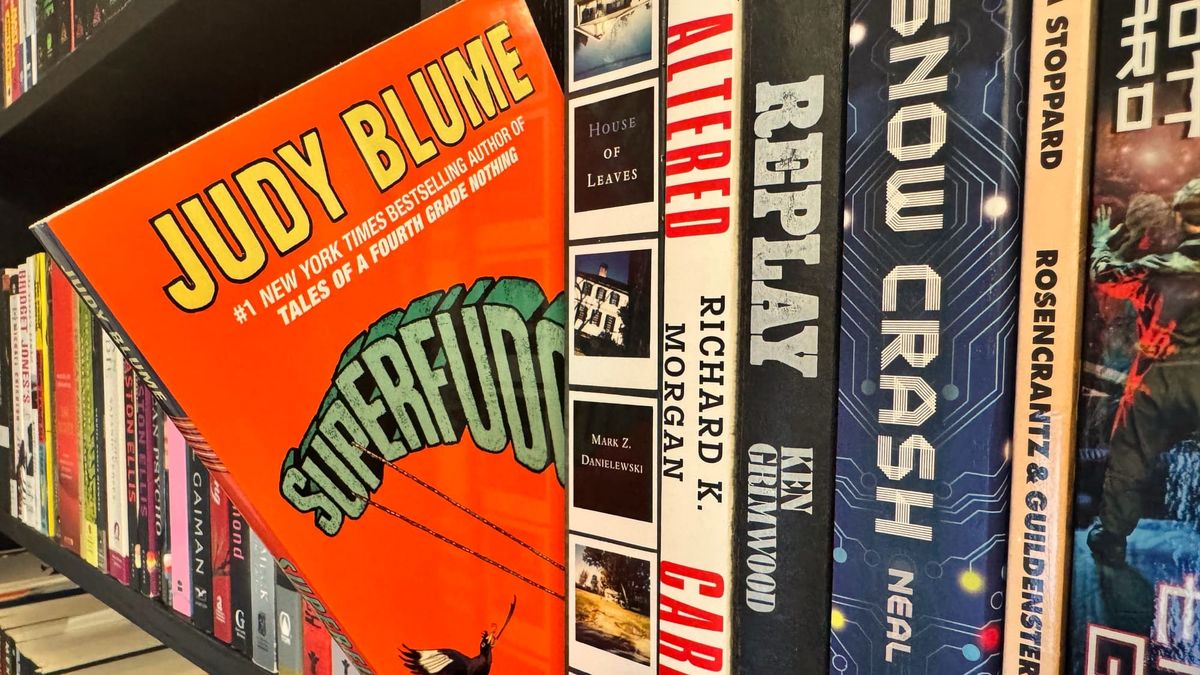
Honesty corner? I'm a guy who's spent twenty years writing about synthetic bodies and corporate dystopias, so when I cite my writing influences, you're probably expecting names like Gibson, PKD, and Stephenson. And sure, those dudes built the foundation on which I've constructed my own cyberpunk universe. But the single most brain-rewiring piece of writing advice that I've ever read came from the literary titan who wrote Superfudge.
It was on Judy Blume's website way back when that I read the sentence: start on the day something different happens. "That's it. That's the post," as my social media people would say. A simple concept, obvious in retrospect, and yet it landed like a hammer to the side of my skull. I think about it with every new story I write.
Here's the thing though. Those seven words might not have meant as much if I hadn't grown up reading Judy Blume, devouring the Fudge series and awkwardly stumbling my way through Are You There God? It's Me, Margaret. I'd lived inside her prose since elementary school, long before I understood she was making decisions with her writing. So when she tells me where a story should start, the advice carries with it her entire shelf, a body of work that looks to me like a pile of receipts.
Now picture the same sentence, verbatim, posted by u/flumber.tugg993 in that hundred-comment thread. I'd have scrolled right past it. Just one more bar in the histogram.
The words would be identical; what's different is everything that comes attached to them. Reddit and Meta spend billions on algorithms trying to figure out what you'll engage with, and a childhood spent reading Judy Blume easily outperforms them all.
Reading widely earns you the one thing the platforms can't vibe code: intimacy.
A first question, asked sincerely
Okay, I know how this all sounds. An indie author with twenty years of receipts telling people to get off Reddit is bound to make people think of Grandpa Simpson shaking his fist at clouds. I don't want to be a gatekeeper. The writing community has enough of those already. Some of them moderate r/writing.
So let me be clear who I'm worried about, because nobody in this mess has it worse than the new writer. Somewhere in that hundred-comment thread is a tiny little writer who just finished their first short story, worked up the courage to ask a real question, and got handed a histogram that smells vaguely of feet.
Thus, the cruelty: the weighting system I described, the one built from decades of reading, is exactly the thing the new writer doesn't have yet. When you haven't read widely, every reply arrives at the same volume. u/flumber.tugg993 and Judy Blume will sound identical.
And that gets me to my only point, really: the format fails hardest the people who come to it most sincerely.
They aren't wrong to be looking either. The connection they seek is universal. Find me people who think like me. Find me people who ponder the same questions. I wanted those things too. It just took me embarrassingly long to find my people, and none of it happened in a thread. I found mine in local writing groups, a few well-placed friendships, a folding table at a comics expo, and the early days of social media, back before it became the wasteland it is today (a eulogy for another post).
Built to hold them
So where does that leave the tiny little writer, or any of us still looking?
Let's look at it another way. Finding your people, the way I've come to mean it, is a smaller and stranger project than anything the word community suggests. Forget subreddits, crowded Discord servers, and follower counts. What you're assembling is a council, a handful of voices you trust because you've done the slow work of knowing their stories.
The first seats should be the easiest to fill because they left their books lying around. Judy Blume sits on my council. So does Stephen King. Ken Grimwood. Nabokov. The appointment process is simple and only takes a decade or so: read someone deeply enough that their advice shows up carrying receipts.
The living seats take longer. A writing group. A critique partner. A redcoat who claims to be American but won't talk to me when "football" is on the telly. None of it scales, but that's okay. A council of five will do more for your writing than an audience of three million ever could.
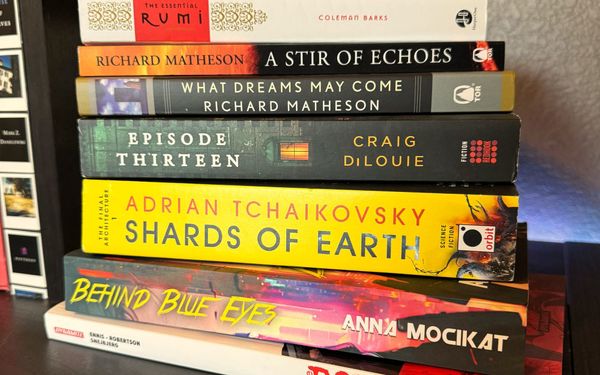
I opened this post wondering why we keep looking for our people in places that were never built to hold them. As it happens, something in your room was built for exactly that.
It's your bookshelf. Your people have been waiting there the whole time.
They're just the founding members though. The shelf is where you learn whose advice deserves weight, and somewhere between books you'll start collecting the living ones: at a meetup, a workshop, a blog's comment section (ahem). One algorithm-free friendship at a time.
Good luck, tiny little writer. Save them a seat.
References:
- Do you plan your entire novel before writing, or discover it as you go?
- What's the point of this subreddit if it's not for posting questions?