A/S/L, Says the State of Texas
Thirty years ago, you could answer that question with whatever lie you wanted. That was what made the internet awesome.


It wasn't always like this. That's a line from Bo Burnham's hit song Welcome to the Internet, where a child born in 1990 talks about what the internet was like in the before time. Now, I can't speak to ARPANET or anything that came before Bulletin Board Systems, but I do know it wasn't always like this is perhaps the saddest and most painful lyric put to music since Weird Al sang My new computer's got the clocks, it rocks, but it was obsolete before I opened the box.
When it comes to the slow, rending death of social media, I'm basically Gene Wilder watching Augustus Gloop get sucked up the pipe. Ever since the worst people came to control the two largest networks in the country (or world?), I've been rooting for the eventual collapse. And for a while, I really thought it might happen. Facebook and Twitter would disappear, and we'd be left with open source alternatives like Mastodon and Bluesky that weren't owned by billionaire lizard people and didn't exist solely to exploit us. Even so, I'd already written off social media as pointless at best and dangerous at its worst.
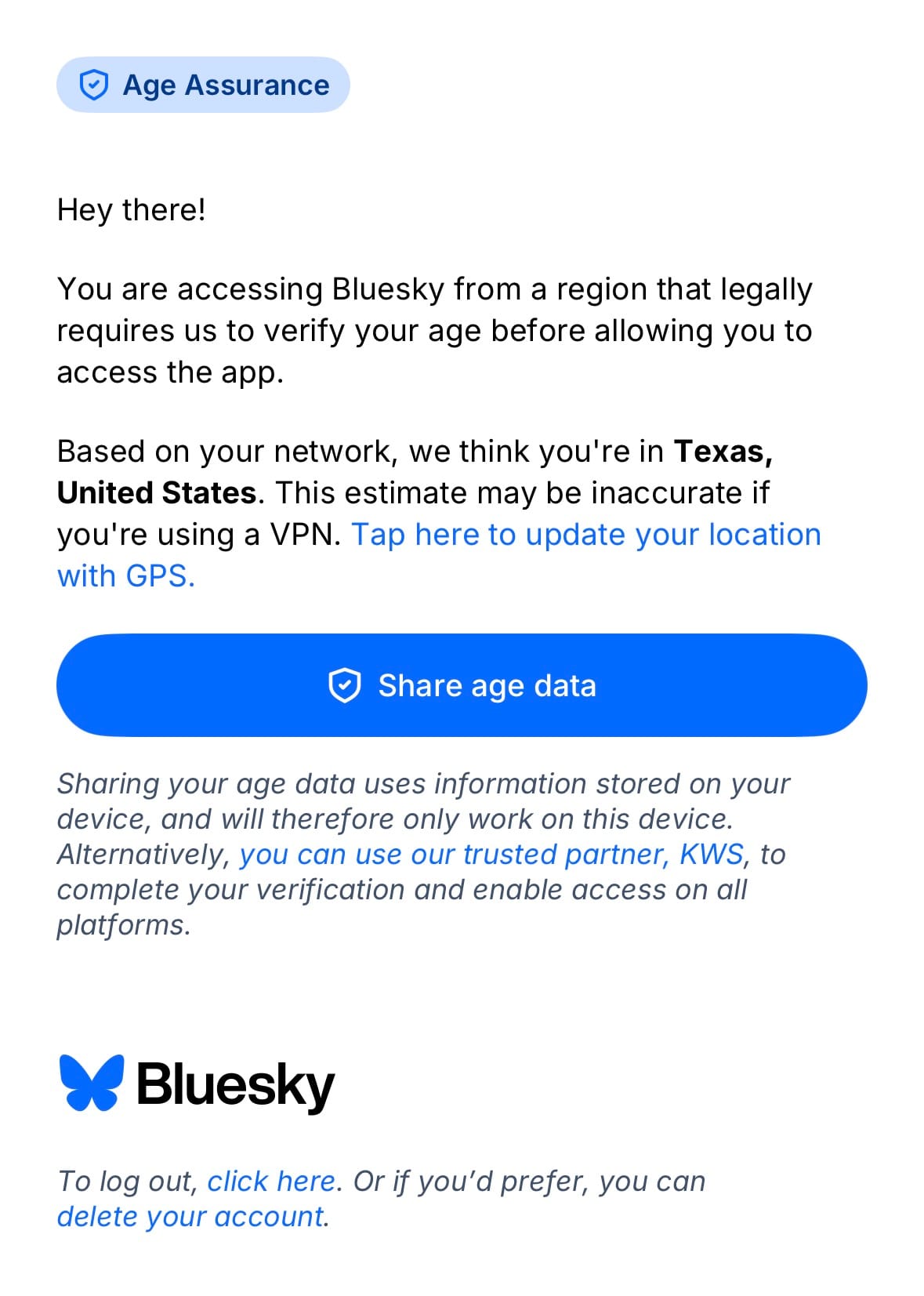
I really did think social media would eat itself. I didn't foresee the Texas State Legislature being a catalyst. On July 9, 2026, Bluesky started enforcing an age verification requirement set forth by Texas Republicans that said if you don't verify your age (read: identity), you can't access this service.
After the initial shock of running headfirst into a wall I didn't see coming, I enabled the relatively new VPN feature in Firefox, reloaded the page, and got right back to my timeline. My next steps were admittedly hasty. I removed all of my old posts and left just two: an impotent condemnation of the new policy, and a link to a service that will quickly delete all of your old posts.
A/S/L?
I don't even remember who turned me on to BBSes way back in the mid-90s. All I remember was that they were new and exciting and when it came time to register an account, I could choose any name I wanted. John Bonn created a lot of accounts back then, as did his estranged cousin, Duke Nukem. Handles were the thing—not real names. We knew without knowing that reaching out with our modems put us in a new kind of danger, and the only real shield we had against that danger was anonymity.
When the internet arrived with IRC and instant messengers, we clung to our preferred handles, even if I did feel ridiculous sometimes being addressed as Beethoven, Xrisis, or Snortmonkey. Websites didn't ask for our names, and for a time, they didn't even ask us to click a button to "prove" we were 18. The internet was free and open and websites could show you naked ladies or dancing babies or crash your computer with a thousand pop-ups.
"It was lawless, Jerry! It was without laws!" – George Costanza
Then... what? Where do we point the angry finger of blame? The government? Capitalism itself? Our own hubris? I like that last one because it implies we were fools for thinking something like the free internet could last forever.
Not in America.
Except, drawing a straight line from the free internet to Bluesky asking me to verify my age skips over a shameful chapter in our online history.
We did this to ourselves
As an author, it was in my best interest to cultivate an online presence for my "brand." But up until I released my first book, I was still publishing blog posts under a handle on a website that wasn't my full legal name dot com. I could still be Xrisis and not Daniel. I understood and accepted why things had to change, why I had to give up my anonymity. What I didn't understand was why everyone else, even people who weren't authors or musicians or some kind of public figure, gave up theirs too. And so willingly.
Facebook never should have worked. A generation that had just made their home on MySpace where handles and personas were The Way suddenly dropped their masks and slapped their ID cards on the table for the chance to connect with their IRL friends and earn likes and comments. The dopamine loop was real and enticing and even I fell victim to its siren song.
We lost our personas, and we could no longer go to the internet to be who we wanted to be. We could only be who we were. So we leaned into that, touched up our selfies on Instagram, lied about our vacations, and created a new, fictional persona irrevocably tied to our real identity. Now our personas expose us instead of protect us, and when The Man comes calling, asking us to verify our age, we can't cry foul.
How can we claim an invasion of privacy when we were the ones who killed anonymity in the first place?
Won't somebody monetize the children
Here's the rub though: handing your name to Facebook for likes was a bad trade, but it was still a trade. What Texas is doing doesn't benefit you in the slightest. And there's no opting out of laws.
If there's a glimmer of hope to be found in all of this, it's that Republicans seem to have forgotten what the WW in WWW stands for, which is why connecting to a VPN in Canada easily bypasses any age verification at Bluesky. That used to be something you would only say about sites that end in -hub.com. And when Texas started gating access to adult content a few years ago, we all shrugged.
So they were cutting off access to porn. So what? We get it. Protect the children and all that.
But now it's Bluesky. Tomorrow it will be Netflix. Or your iPhone. SB 2420 requires Apple/Google to verify ages before users can download apps.
Apps. Not adult apps. Not social media apps.
All apps.
The cost of entry? Scanning your driver's license. Putting in your credit card. Letting AI guess your age by scanning your face.
Hell, why not some DNA while we're at it?
Someone on Reddit asked what other gamers would do if Sony started requiring age verification on the PlayStation. The responses ranged from "boycott Sony" to "whatever, they already have all my information, why do I care?"
You care because anonymous speech is free speech, and even though the courts haven't been willing to say that age/identity verification laws violate the First Amendment yet, that doesn't mean they don't. You think Hamilton and Madison would have written The Federalist Papers if they had to use our trusted partner, Totally Private Identity Company Not Owned by Peter Thiel, to complete your verification and enable access on all platforms?
No way, John Jay.
The more we allow them to cut away our anonymity, the more points of no return we hit, until one day the dream of a free internet dies for the last time. And I think we're closer to that day than anyone realizes.
Then they will know everything about you. Meta knows who you know. Google knows every website you visit. Instagram repurposes your photos to train AI. And now, thanks to Texas, the government gets to dip its hand in all of it.
I hate to throw around the F word without good reason, but...
That's fascism if I've ever seen it.
A new shield for a new danger
In 1995, we hid behind our silly handles because the internet was full of strangers, and as every latchkey kid knew, strangers were danger.
In 2026, we're hiding behind VPNs. Now the law is the danger.
It wasn't always like this.
Now it is again.
And the hardest part isn't the wall or the face scan or the trusted partner waiting to verify you. It's everyone around us obeying in advance... shrugging and muttering that they already know everything anyway, so why fight it.
The internet has come to its logical conclusion.
For profit. Privacy-free. Heavily controlled.
Thirty years online, and we're right back where we started: hiding behind something, just trying to stay safe.
Only this time, it's not the strangers we're afraid of.