How to Turn an Existing Short Story into a Novel
Pamela Koehne-Drube over at Novlr wrote a great framework for expanding a short story into a novel. It's like she was reading my diary.

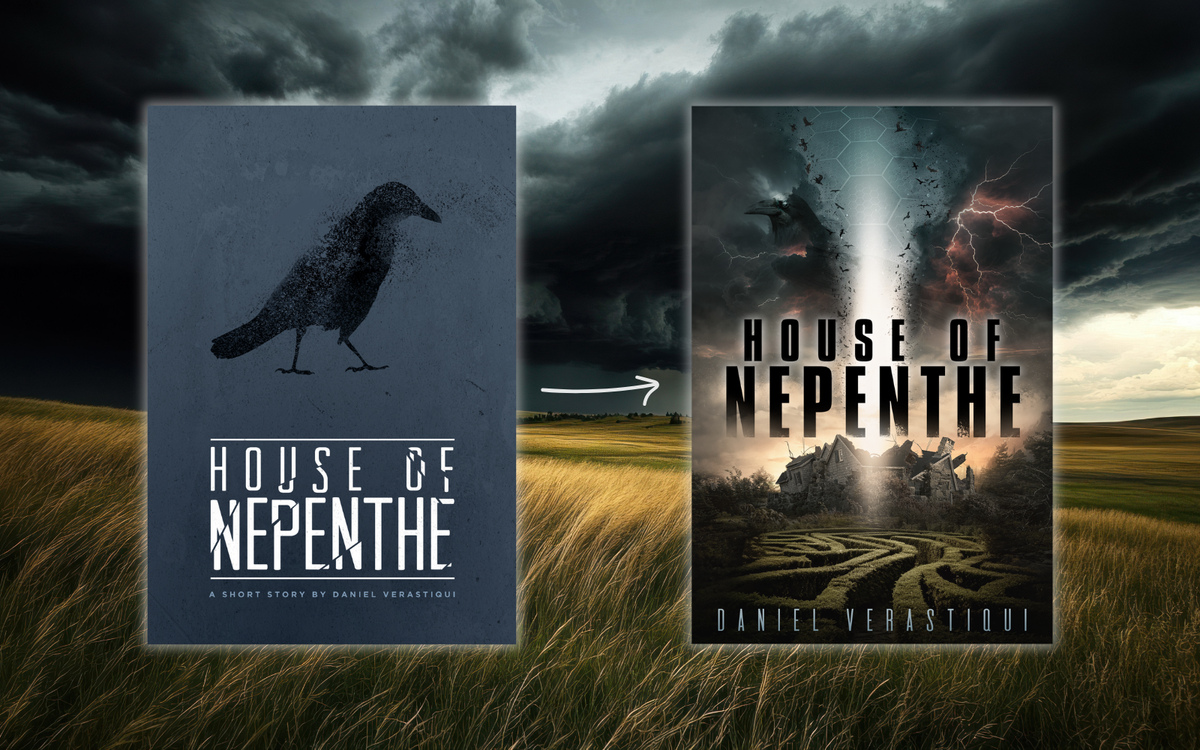
I've been a fan of Novlr for a long time, and anytime I see a piece from Pamela land in my inbox, I set my work Slack status to ⛔AFK BRB BBQ and dig in. So when her latest post about turning an existing short story into a novel arrived a couple of weeks ago, I did a double-take... because that's exactly what I did with House of Nepenthe.
I want to send you over to Pamela's article before we go any further, because it's worth reading on its own merits. She lays out a clear, practical framework for turning a short story into a novel without just padding it out. Go read it. I'll be here.
Back? Good.
Here's the thing though: I didn't follow her advice. I couldn't—because the article didn't exist four years ago when I decided House of Nepenthe would work better in novel form. But when I read through her framework, I kept nodding along, because it maps almost perfectly onto the decisions I made by instinct, raw talent (citation needed), and dumb luck. So consider this a field report from someone who stumbled through the process and somehow ended up in the right place.
Is it worth it?
Pamela opens this section with a reality check, and it's the right place for anyone considering this type of undertaking. Before you write a single new word, you have to ask yourself whether the story actually has more to give or whether you just love it too much to leave it alone. As she puts it:
"Just because you want to, doesn't always mean you should."
I had been sitting on the short story version of House of Nepenthe for years, and though I loved its intimate focus on a disillusioned engineer and his spurned ex-wife, I always thought it had more to offer. That was mostly my own doing, because once the story was finished, it became canon in my mind even though it was never officially published. Ken Barnes became a known entity in the Vinestead Universe. His work, specifically the House of Nepenthe, even became a plot point in Brigham Plaza.
He grew in importance, and though it wasn't originally attributed to him in the short story, he became the inventor of the Guardian Angel biochip, the one piece of technology people have been fighting wars about for decades in my novels. I looked at this story, saw how pivotal his death would be, and the expansion that followed felt natural. This moment in 1997 in Austin, Texas is massive, and it ripples across the next hundred years.
I saw new characters get sucked into orbit, and before I knew it, a larger story started to unfold. Instead of a one-off side quest to the Vinestead Universe, it became an inflection point and a story that needed to be told. The scale multiplied. The new characters brought their own baggage into the mix. And since very few people had read the original short story, this looked like a great opportunity to go big in the way only Vinestead Anthology novels can.
Multiple POVs. Genre-mixing. Enough violence and nudity to keep the squares away. That sort of thing.
For me, for this story, I couldn't think of many reasons why I shouldn't.
Decide what to keep, change, or cut
Pamela doesn't sugarcoat this one:
"Think of your short story as source material rather than an outline."
If the novel version of House of Nepenthe is an MCU blockbuster with all the spectacle you'd expect from high-octane dystopian cyber-thrillers, then the short story version is an A24 short film about processing grief and letting go. Originally, the story switched back and forth between Ken's experience in the House and his ex-wife Delia's experience in the hospital. Where he was trying to escape a digital prison he'd built for himself in virtual reality, Delia was only doing grief work. She was a literary character dropped into a sci-fi context, and it worked as a counter-balance, but only at that scale. In novel form, she wouldn't have had much to do besides feel pain, confusion, and anger for 400 pages.
So I dropped her POV. It was a tough choice, because losing the people we love is something everyone does. It's a universal experience about processing grief, which I love to examine in small doses, because really that's all I, as an author, can handle. I prefer outbursts of humanity, of pathos, instead of long examinations of how being forced to care for someone affects your agency and sense of control. To make the novel version work, I had to get outside of her head, make her a suspect in her own ex-husband's shooting, and filter everything she says or does through multiple lenses. How does our grief look to other people? Real? Manufactured?
So despite taking a backseat to Ken's best friend Patrick and a disgraced FBI agent named Lee, Delia remains an important part of the story. She represents the normal folk who get caught up in the aftermath of these grand adventures, who want nothing more than to go back to their regularly scheduled lives and forget any notion of hackers and corporate conspiracies and the slow march into technological dystopia.
Real victims don't get a spotlight in the Vinestead novels, but they're always there, in the background, silently increasing a body count that seemingly has no upper limit.
Build your world
The advice here is about excavating what lives at the edges of your short story: the political situation, the economic reality, and the cultural context. As Pamela puts it:
"Ask yourself what exists beyond the edges of your short story's frame."
Okay, this is where I kinda cheated. While other authors might have been inventing a world to surround their story, I already knew mine was firmly planted in the Vinestead Universe. That meant, if the story took place in 1997, then I knew X would be enrolling at UT Austin the following year, Calle Cinco's The Reaping would follow soon after, and by the time the first human transferred their mind into a synthetic body, the aftershocks of Ken's shooting would be echoing at their loudest.
There was almost nothing unclear about the world surrounding this story, and most of the "plugging in" work had been done in my head in the years since finishing it. I did have to bring in a few new characters and while fleshing them out, I discovered new and interesting things about the world in 1997. I met the engineer who created VNet. I discovered who was CEO of Vinestead International before Arthur Sedivy. And I watched with curiosity as the House of Nepenthe tech made its way into the hands of Anela Zabora.
I definitely had an advantage here. The novel fits so cleanly into the larger universe that you'd likely mourn the loss of the bigger picture if you ever read the short story. It would be like going to Chuck E. Cheese and only eating some pizza without ever going into the game room. I mean, it's right there. You can hear the buzzers and the screaming and the laughing. Why dip into the Vinestead Universe if you're not going to go full tilt?
The last thing I wanted was to simply drag Ken and Delia into 400 pages of "more of the same." The world got bigger, the stakes got higher, and the story is now better than I ever imagined when I first wrote these lines:
You’ve reached Delia. I’m probably screening calls, so start talking.
“Hello, Mrs. Barnes? This is… this is Deputy Shane Nichols with the Travis County Sheriff’s Office. We need you to come down to St. David’s North off MoPac. It’s about your husband…”
Pamela's article is worth bookmarking for any writer sitting on a short story they can't stop thinking about. The framework she lays out is sound, and if my experience is any indication, you might already be further along than you think.
House of Nepenthe releases June 2, 2026. If you've been following the Vinestead Universe, this is the story you didn't know you were missing. If you're new here, well—there's a whole game room waiting for you.