Objection! This Isn't Funny at All (How Pauly Shore Lied to Me About Jury Duty)

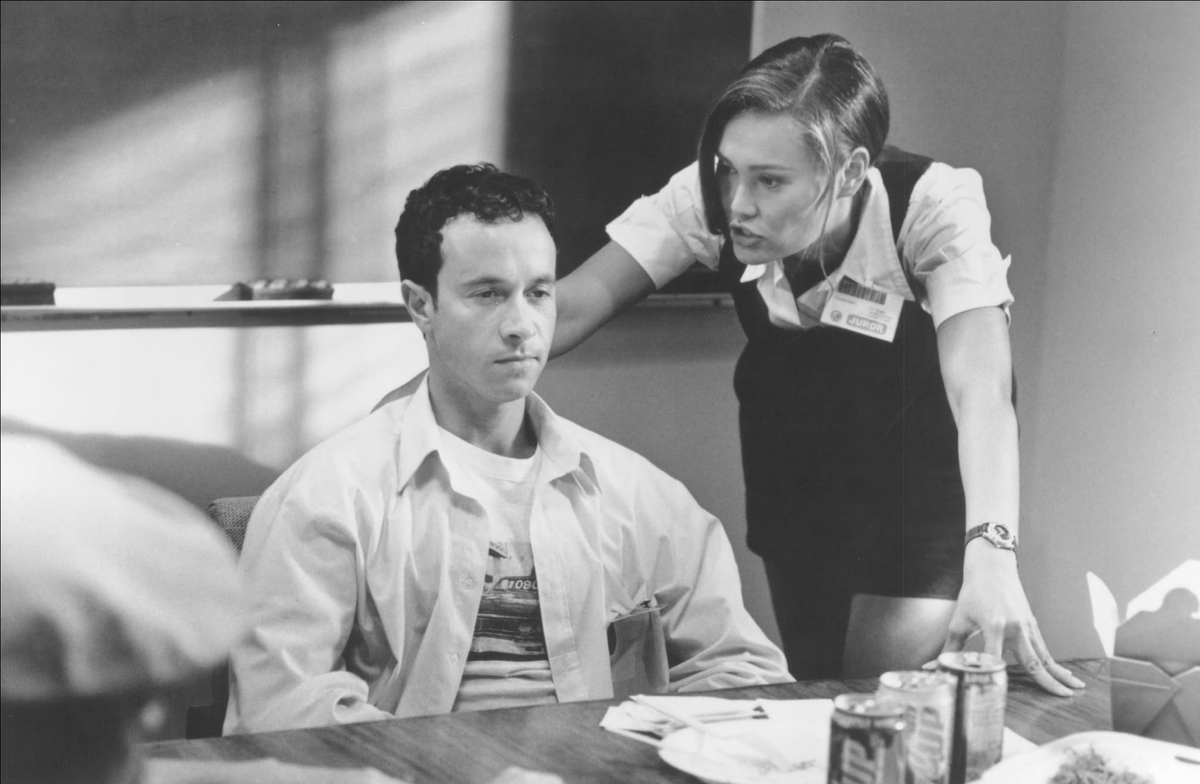
There is a small subset of people in this country who don't recognize the comedic genius of Pauly Shore's work in the 1990s, and if you happen to be in that camp, I'd like you to stop reading right now, as I don't want to risk bringing any joy into your cold, humorless life. For the rest of you who can quote Jury Duty, In the Army Now, and Bio-Dome from memory, let's carry on.
It all started the day after STAPLE! when I was compelled by the county of Travis in the state of Texas to appear before the court and perform my civic duty as a juror. This, of course, sent me straight to Jury Duty, as I hadn't seen the movie in forever, and I needed to know what I was in for. As it turns out, rewatching Pauly Shore and Tia Carrere would be the most enjoyable part of the entire process. The rest could be characterized as a slow descent into existential madness, the kind that makes you want to re-read Beckett's Waiting For Godot or Camus' The Myth of Sisyphus.
But I'm jumping ahead. Let's start at the beginning.
"Know him? We cheated our way through high school together, didn't we, Bobby?"
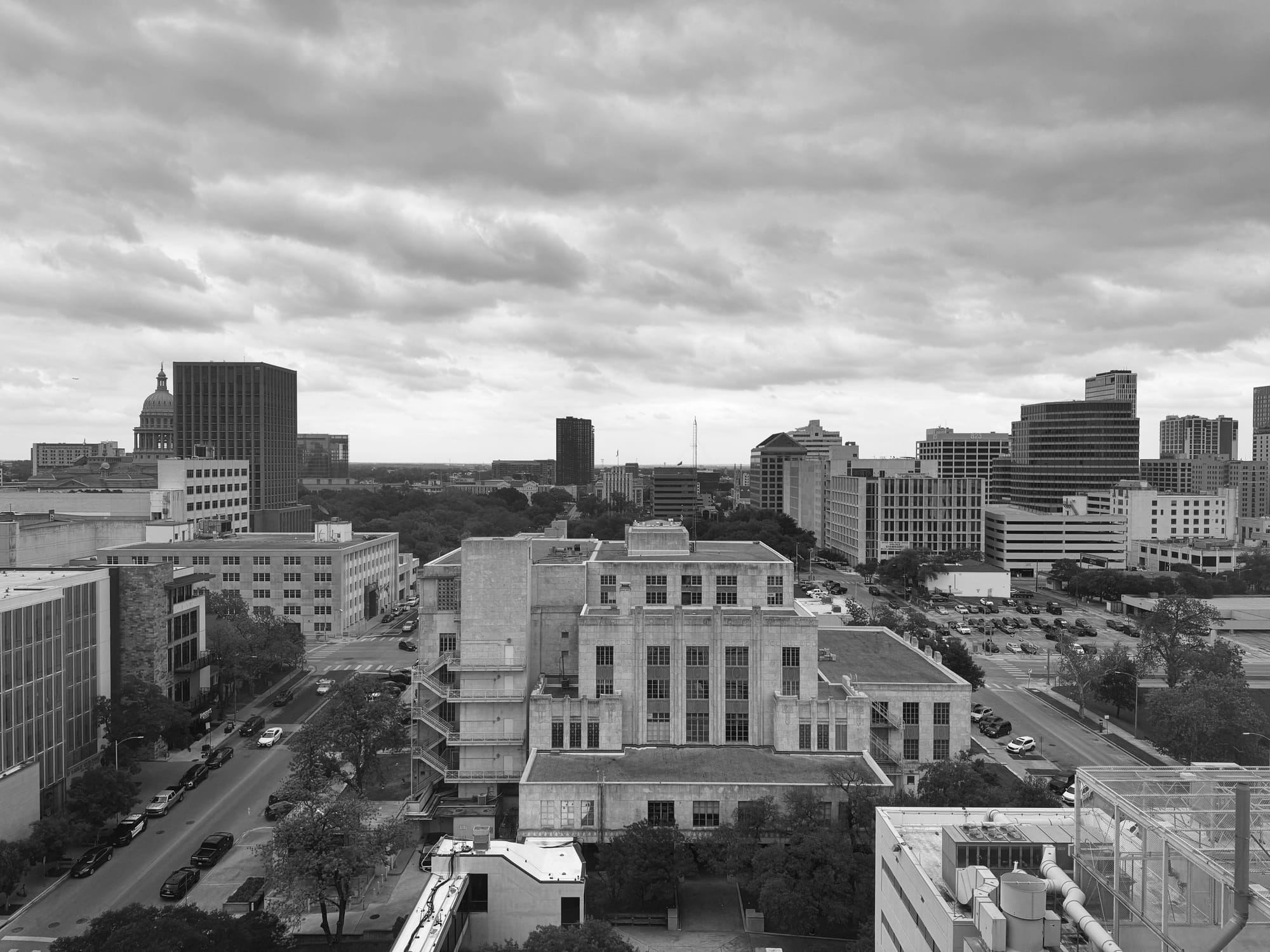
I'd only been called in for jury duty once before, way back before the old municipal courthouse on 7th and I-35 turned into Violet KeepSafe Storage. I remember showing up in my best polo shirt, sitting in a hallway for twenty minutes, and then being told to go home. And since nothing ever changes in this world, that's exactly what I expected to happen again.
I should have known something was up when I arrived at the District Courthouse on 10th and Nueces on Monday morning. Instead of the handful of potential jurors I'd been part of before, I found myself one among a hundred. This, I learned, is common in felony trials, as they have to find just the right people to judge such serious accusations. Still, my brain wouldn't stop imagining there were multiple cases happening, and that some of us would get dismissed out of hand after half an hour.
Instead, we were all ushered into a court room where the defendant, defense attorneys, and prosecutors were all sitting there looking at us. That's when the whole tone of this thing changed for me. Suddenly, things were serious. This man, presumed innocent, had to sit there and watch a gaggle of random people enter the room talking and laughing amongst themselves. Here he was, under the most stress in his life, and everyone else was just treating it like it was any other day.
And it got worse as voir dire began.
Everyone was cracking wise as the prosecution and defense led us through a series of questions intended to weed out bias and... I don't know... lack of mental fitness? Some people overshared personal information. Some gave answers clearly designed to disqualify them from service. Some argued against the Fifth Amendment, saying they wouldn't be able to judge someone not guilty unless they took the stand and said they didn't do it. Classic Pauly Shore line there, I tell you.
As bothered as I was by the levity, I was also locked in a battle with both lawyers, and I passed most of the time by trying to figure out why they were asking certain questions and how the answers benefited their case. It's as if they asked, "Who here believes hitting a child on the head with a hammer is wrong?" And I guarantee if they had asked that question, not all of the hands would have gone up.
The selection process took so long that we had to break for lunch, and I ate the first of three lunches at Phoebe's Diner on 11th Street. When we resumed, I was finally asked a question (my juror number was in the 60s), and I tried to answer it as blandly as possible.
And it wasn't that I didn't want to be on the jury... but I would have loved to ride the momentum from STAPLE! into some marketing and community building. If I didn't make the jury, that would still be a possibility. And yet...
Serving on this jury would fall under my Fuck it; never done this before initiative for 2026. If anything, it would be interesting to see how it all worked, to learn about the process, and to deliberate with the common clay of the new West on charges that could send a man away for decades.
I texted Dom to let her know I had a high jury number, that I probably wouldn't be selected to serve, and that I'd be home in time for dinner.
Twenty minutes later, I was walking from the audience to the jury box as the 13th juror selected. But Daniel, you say, incredulous, aren't juries made up of only 12 people? You're right to question, my friend. And we'll come back to that. But for now, how did they skip over 50+ potential jurors to get to me? That's what I kept asking myself as I snaked my way out of downtown at rush hour.
"This trial will be a long and involved one. It will be a true test of your commitment to our judicial system."
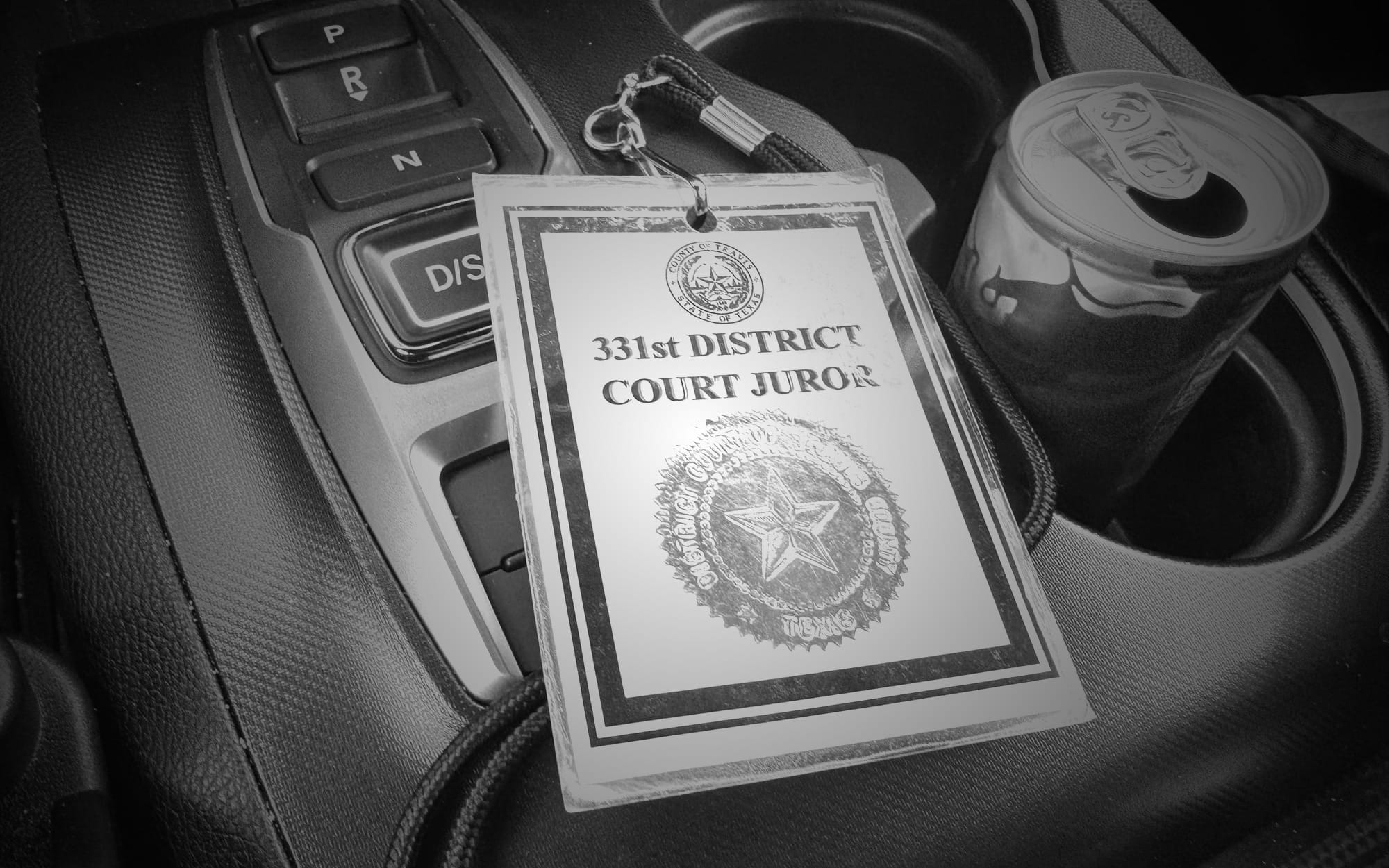
The trial began on Tuesday with opening arguments from both the prosecution and defense. This is when we finally learned how all of the questions in voir dire combined to fit a list of charges. I won't get into the details here, but suffice to say, I was overcome with worry that this was going to end in a very gray area case. Perhaps not a he said, she said stalemate, but one where you'd have to have a focused and dedicated team to arrive at a single verdict.
Looking around at my fellow jurors, I was not very hopeful of that outcome. I'm not saying there was something wrong with any of the 13 other people on that jury, but they were a clear random sampling of people living in Travis County. With that many different personalities, I would have been surprised if we could come to an agreement on where to get lunch.
The case took two days to present, with the prosecution calling their witnesses in an order that, I believe, was supposed to build a strong body of evidence against the defendant. And yet, it felt more like a series of PowerPoint presentations or disconnected accounts surrounding something that happened, but that we still hadn't been told what. Maybe we were supposed to piece it together on our own? Maybe our imaginations were supposed to fill in the blanks?
We weren't allowed to discuss the details of the case during our lunch breaks, so when we were back at Phoebe's Diner, my new friend J and I talked about our kids, careers, and of course, my books. Emboldened by STAPLE!, I was now mentioning my books to anyone who would listen. J politely sat through my extended pitch because he's a good person and we were stuck in the same predicament.
Some observations from the two days of arguments:
- I found the process of showing evidence interesting. Submit exhibit X, any objection? Permission to publish? Permission granted.
- All of the little customs intrigued me. No one said, "if it pleases the court," but they always said "your Honor" and made an attempt to rise from their chair, even if it was only a few inches.
- The cross examination by the defense was funny because it went against every convention of polite conversation that I was raised with. Instead of saying things like "Did you interview the bartender," the lawyer would ask, "Did you bother to interview the bartender?" I clocked every one of those little digs, and you can bet that will show up in a book someday.
- A lot of fake emotion came through from both sides of the court. Words like "outrage" and "ridiculous" and "incompetence" were thrown around, without the slightest non-verbal indication that any of the emotions they were feeling were genuine. This is akin to someone asking if you ate the last cookie and you saying "How dare you, good sir!"
The case didn't actually wrap up on day three of this ordeal. The prosecution rested, but the defense wasn't ready to rest just yet. This delayed a coming event that I had been secretly hoping for ever since sitting down in the world's most uncomfortable office chair—the dismissal of the jury alternates. In my mind, there was a one in fourteen chance I'd be an alternate and get to go home!
Alas...
"You've heard the testimony, and the law has been read to you as it applies to the case."

Luck is a fickle thing. I've always maintained that I live a very Even Steven life. No big ups. No huge downs. Just everything averaging out right in the middle. So therefore, it came as no surprise when I was identified as an alternate juror. And it was even less of a surprise when I learned that, not only did I not get to participate in deliberations, but I also wasn't allowed to go home.
Instead, a new friend (D) and I were shown to an empty room and told to stay put. Lunch would be brought in. We were free to discuss the case. But under no circumstances could we return to our previous lives. I thought back to my initial assessment of the jury mixture, how gray the case had turned out to be, and calculated the odds that they would come to a decision quickly (unlikely) or at all (also unlikely).
When D asked what I did for a living, I told him I was a writer. Thus we began waiting for Godot, and the hours stretched on and on. We deliberated the case amongst ourselves and couldn't agree. We dove into the gray area of what had happened. We paced the small room to relieve the pain of extended sitting.
Like a Civil War soldier fighting on the plains of Gettysburg, my thoughts turned to home, to my wife and children, whom I had not seen in what felt like a fortnight. Dom was coming off a weekend of watching the children while I was selling books at St. Ed's, and now here she was trying to manage it all again while the trial gave no indication of ending. Not that she couldn't handle it, but as Cameron Poe taught me way back when, many hands make light work. As for real work, I'd kindly remind the jury that I'm a middle manager, and as such, work actually proceeds more smoothly when I'm not in attendance.
Looping back to Pauly Shore, the real conflict of the movie comes into play as the trial moves into deliberations. Everyone is ready to convict. One guy has Knicks tickets. Tia Carrere needs to leave because she's got to compete in the Miss Universe pageant the next day. But Pauly needs his hotel room, so he's intent on dragging out deliberations as long as possible. Over the next few days, he even starts to change some minds.
I won't lie; I was looking forward to arguing with people. There's nothing I love more than thinking I'm right and beating someone until they accept it. Logic and reason are absolutes in my book, so if you're looking at a case and being asked does the evidence support this, then to me, it's a pretty straightforward deliberation. Don't bring your biases. Don't bring your personal experience and feelings. Just look at the facts, ma'am.
While I was mourning the loss of that experience, of pulling a Pauly Shore to show this man had been railroaded (in the movie, not reality), I was also aware of how rare it was to be an alternate juror, to sit through an entire trial absorbing all of the evidence and testimony, only to be locked away and excluded from the final decision. What are the odds on that one?
For two days, my life was on hold, stuck in a holding pattern. Steeped in existential panic at the open-ended nature of this delay. And yet, I told myself it would all be worth it, that the jury would eventually arrive at a verdict, and I will have participated in something that had meaning.
"He has left me little choice but to declare a mistrial. The jury is dismissed."
Honestly, I saw this coming. When we were called back into court for the jury to ask about the definition of words, I knew. When we were called back to ask if we (the jury) could agree on one charge but not the other, would that be okay, I knew. When, late afternoon on Friday, the jury declared they could not reach a decision and the judge said (essentially) go back and try harder, I knew.
The fact that D and I couldn't agree on a verdict ourselves said everything about the gray area nature of the case. We had the same evidence, but it convinced us (or didn't) in different ways. We'd listened to the same people dodge questions on the stand, fake offense when they thought they might get in trouble, and readily admit they didn't know what happened. And we couldn't agree.
So what hope did twelve random people have?
I stuck around for a few minutes after the judge declared a mistrial, and to my surprise, the judge, the prosecution, and the defense came back into the jury room to discuss the case. Though I wasn't there for the deliberations, just hearing about it after the fact, the way some people argued about the definition of words, the way some people were set in their decisions the moment they walked into the jury room, made me want to throw myself out the nearest window. J shared a detailed account of deliberations with me later, and I realized D and I were the lucky ones after all.
All we had to do was sit in a room and make polite conversation, which could be argued is a worthwhile endeavor given the circumstances. But to sit through a trial and deliberations only to come away with nothing? What a waste.
At least the judge in Jury Duty was able to point a finger squarely at Pauly Shore's selfishness. In my case, no one was to blame, and everyone was to blame. Except D and me. We were spectators who shouldn't have been on the jury in the first place.
The juror rests
It's easy to get caught up in my own story, bemoaning the loss of momentum from STAPLE! and the time I missed with my family and/or job. But even now, a couple weeks removed, I'm not able to fully commit to the bit. Yeah, it's kinda funny to be selected for a jury, made an alternate, and spend all that time just to end in a mistrial. But then I think about that (presumed innocent) dude and the (alleged) victim and how stressful this must all be for them. The levity I looked down on during jury selection is the same levity I'm trying to cultivate here, and it doesn't quite sit right with me.
If anything, my existential crisis is overshadowed by a new fear: being judged by a jury of my own peers. Forget sending kids to prison to scare them straight; just let them sit in on jury deliberations until they realize that this is how their guilt is decided. This is the method by which the course of their lives is forever altered. Or not.
As absurd as this experience was, it is also tremendously scary to realize this is actually how it works. One day, you may find yourself sitting in a courtroom, watching your lawyer ask questions of a hundred random people, and wondering how they can be so flippant about everything, how they can make jokes at a time like this.
Maybe it's gallows humor. Maybe it's people's natural inclination to assert normalcy in an uncomfortable situation. Either way, the stakes are real, and no matter how funny my answer to a voir dire question is (and it will be), it's probably not going to land if you're the defendant.
It will be a while before I figure out what to do with this feeling. In the meantime, I'll try not to commit crimes. Any more crimes, that is.