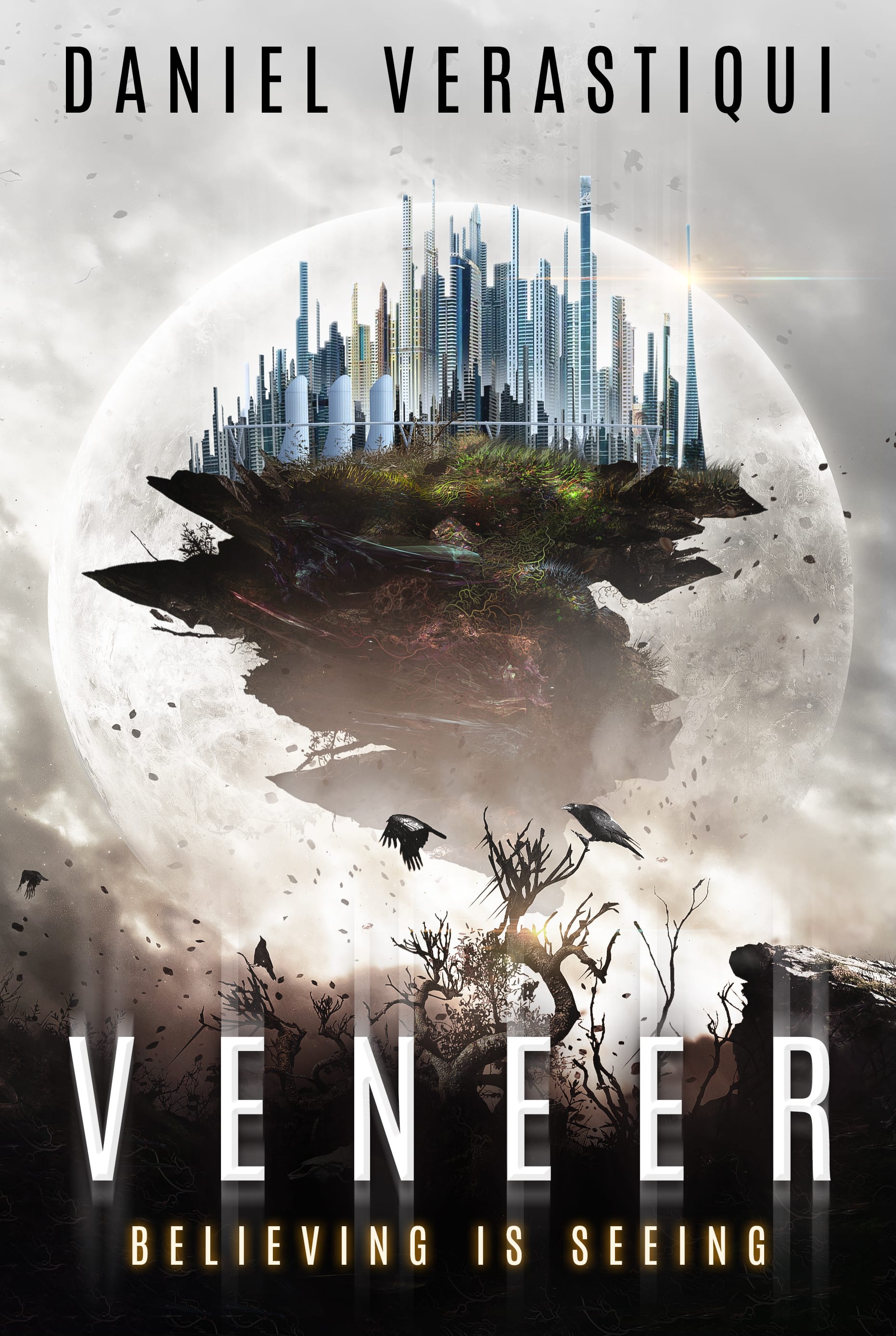
Veneer (2011)
In the 22nd century, augmented reality has transformed society. Deron Bishop, who struggles to control the Veneer, faces a stark choice when his ability to access the virtual world is disrupted. As he grapples with a reality he barely recognizes, he must choose whether to abandon or reclaim the life he once knew.
Previews, Reviews, and More ->Praise for Veneer
"It was seamless, well-orchestrated, well-researched, the lingo was slick (unlike a lot of harder science fiction), the characters, the cities. AHh! It was just so very well put together like an intricate puzzle and worked out perfectly in the end."
- A. Cox, Amazon Review
"The writing is really tight, the story grips you right from the start, the characters are fully realized, and the central conceit of the book (which I won't spoil by going into) is very, very smart."
- David Gaughran, Amazon Review
"The suspense of the story makes you want to keep reading, but Verastiqui's unique take on how we may soon interact with each other sets this novel apart."
- Todd P., Amazon Review
Starring
Deron Bishop - He was the last kid in his class to learn to reconcile, to bend the veneer to his will. Now he'll learn that the only thing worse than not being able to control the veneer is not being able to see it at all.
Sebo Kahani - Deron's best friend and former student of Dahlstrom Academy, where the very brightest are sent to study.
Rosalia Collier - Deron's girlfriend, who sees his struggle with the veneer not as a flaw to fix but a person to stand beside.
Russo Rivera - A bully in every sense—violent, entitled, and indifferent to the damage he leaves behind.
Jalay Chapman - Russo's shadow. He chose the wrong side early and has been making it work ever since.
Ilya Yuschenko - Rosalia's classmate. His interest in her is friendly the way a knife is decorative.
Author's Note
After Xronixle, I knew I didn't want to write another virtual reality story. Augmented reality was starting to emerge as its own idea in the early 2000s, and I became obsessed with a single question: if AR grew to consume everyday life, how long before people forgot it was technology at all? How long before a kid born into that world assumed the ability to reshape reality was just something humans could do — like breathing?
That question pushed me far into the future, into city-states and narrowed worlds where I could control the scope of the story. Originally, I didn't plan for it to connect to Xronixle. And yet the same terminology kept appearing, the same ideas kept surfacing, and eventually it became clear these two books shared a universe—separated by more than a century, but unmistakably the same world.
The image that really drove the story was simple and a little cruel: a teenager who can't see what everyone else sees. While his classmates reshape reality on a whim, Deron looks at the same street and sees blank concrete and cardboard. It's one thing to feel like an outcast in high school. It's another to be literally unable to see the world the way everyone around you does.
From there, the characters took over. What emerged was a story about identity, the masks we wear, the things we hide from each other, and what it means to finally close the book on childhood. Veneer is my best-selling book, and I've always suspected it's because those themes—however far into the future you dress them—are ones nobody really grows out of.